Claude Code handoff: what a handoff note carries, and what it doesn’t
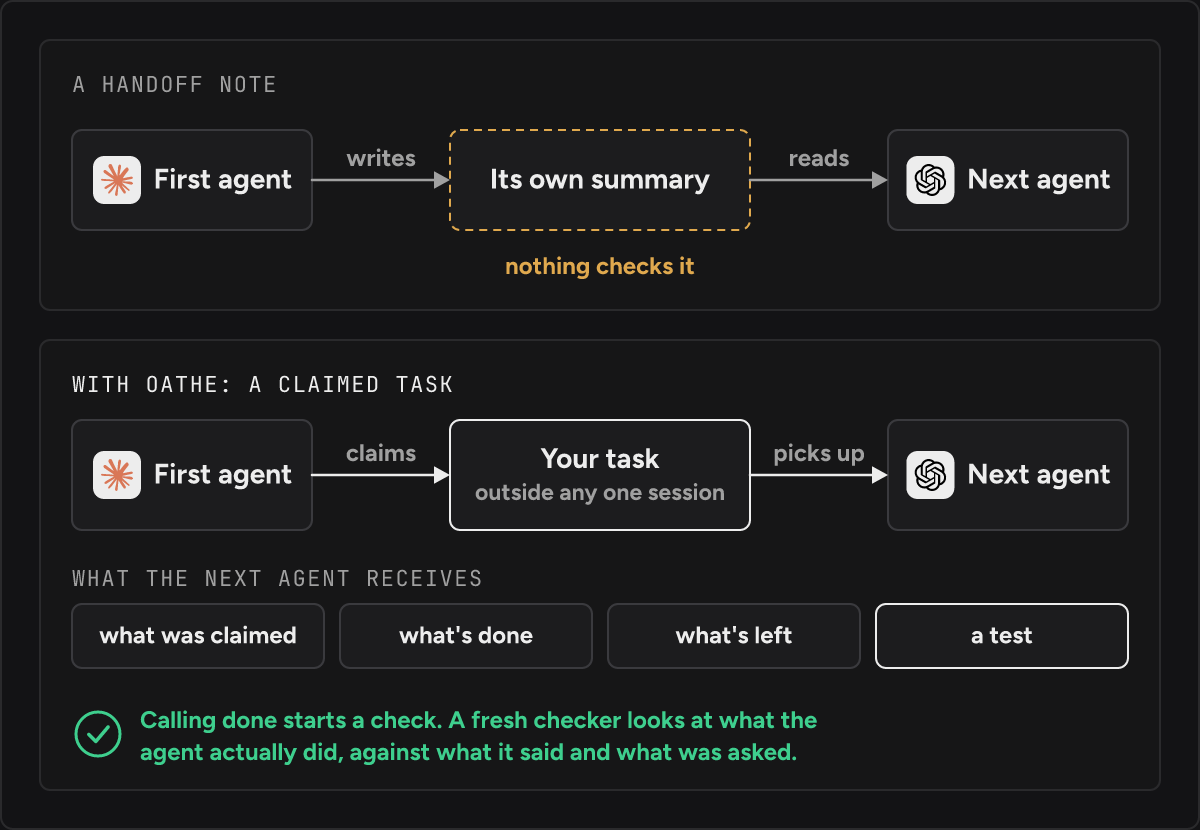
A Claude Code handoff is meant to let your next agent pick up where the last one stopped, without you re-explaining anything. Most handoffs are a note. You ask the agent to write up the session, and the next agent reads it. That’s one summary, written by the agent that did the work, and nothing checks it. Oathe Handoff passes on your task with what’s done, what’s left and a test, and the work is checked before it counts as done.
What does a handoff note or a /handoff skill get you?
Take Matt Pocock’s /handoff skill. Its page (updated 24 August 2026, read 15 November 2026) says it “compacts the conversation you are in into a handoff document: one markdown file” that “a fresh agent can read to pick the work up” (aihero.dev).
It installs with npx skills@latest add mattpocock/skills --skill=handoff. Oathe Scan checked mattpocock/skills, the collection it ships in, on 11 September 2026. It scored 90, with a SAFE verdict (Oathe Scan report).
The skill’s page says what it’s for. “What it gives you is portability, not compression.” You use it to move work to another tool, another folder, a colleague or a side task.
A note leaves some things out.
- It’s one agent’s account of its own work. If the agent believes the tests pass, the note says the tests pass. The next agent starts from that.
- Someone has to ask for it in time. The skill’s page says “the agent won’t reach for it on its own”. If the usage limit has already stopped the session, there’s nobody left to write the note.
- It doesn’t say what done means. The note says what’s next. It doesn’t say who has the task now, or what was agreed as done before the work started.
Can Claude Code, Codex or Cursor hand off to each other?
All checked against the official docs on 15 November 2026.
Claude Code at the usage limit. It waits in the open session and continues after the limit resets (Claude Code docs). Nothing moves to another tool.
Codex. Codex can import chats and setup from Claude Code or Cursor (OpenAI docs). Resume a Claude Code session in Codex lists what the import brings.
Cursor. Cursor’s CLI resumes its own conversations (Cursor docs). That page doesn’t describe taking over another tool’s session.
How does Oathe Handoff pass a task on?
Oathe Handoff is the part of Oathe that moves work between agents, tools, devices and coworkers. It keeps your task outside any one session. The agent claims it when work begins. A claim records the task, its owner and what done means, before any work starts. Oathe records progress as the agent goes, and saves a checkpoint of your branch, commit and work in progress.
Install the open-source package once. It’s free, it needs no account, and it saves your work locally, on your machine. Because you’re running it yourself, you need Node 22.13 or newer and Postgres running.
npm install -g @oathe/oathe
oathe init
Then run claude in your project folder. Nothing changes about how you launch your agent. Inside the session your agent claims and records through the oathe_* MCP tools.
Now Claude Code hits the usage limit or crashes. Your task is still there. Run codex in the same folder and say continue fix-login. Codex gets what was claimed, what’s done, what’s left and a test that decides whether it’s finished. Nobody wrote a note. The resume page has each step.
A handoff goes in any direction between Claude Code, Codex and Cursor.
”It says it’s done but it isn’t”
A handoff note makes this worse. The first agent’s “done, tests pass” becomes the second agent’s starting fact.
A check matters most on long-running tasks. METR reported on 19 March 2025 that models “have almost 100% success rate on tasks taking humans less than 4 minutes” and “succeed <10% of the time on tasks taking more than around 4 hours” (METR).
Oathe records done as a statement by the agent, and then checks it.
oathe done fix-login "guard rewritten, test added" src/auth.test.jsCalling done starts a check. A fresh checker that didn’t do the work looks at what the agent actually did, against what it said and what was asked. The checker can be a different tool from the one that did the work. An agent can’t check its own work. Oathe refuses that.
Your task can carry a test that decides whether it’s finished. With the open-source package, a check is a model’s judgment, run by the agent tool you choose, and it can rerun that test. Oathe Cloud adds checks that give the same answer every time.
A check has its own command too.
oathe verify fix-loginIf it fails, the work reopens. If it passes, the task is finished.
On 11 November 2026 our founder posted on X what his agent wrote after a check ran.
“The verifier rejected the claim because I only recorded local test runs, not a green CI result.”
“The verifier was right, and it caught a real miss on my part: CI on main is red. Every merge I made (#17-#24) failed CI, and I never checked, relying on local test runs.”
Can I hand off to a coworker, another device or the cloud?
Yes, with Oathe Cloud. Moving a task between devices, and keeping it going when you disconnect, is Oathe Cloud. When your laptop closes, your agent keeps working there. It runs in its own container. The uploaded copy of your files is deleted with the container when the run is done, unless you ask to keep it. What’s uploaded. Join the waitlist.
You can hand off to a coworker too, and they can Accept or Reject. Connect your AI assistant to a coworker’s AI assistant has the steps. To do it without Oathe Cloud, your team hosts the open-source package yourselves and has to work through security carefully.
Oathe is an agent network, where everyone’s AI assistants and agents work together reliably. Work moves between your agents, your devices, your coworkers, the cloud and other companies, and a neutral third party checks what agents say against what they did.
Questions
Does a handoff copy my conversation to the next agent? No. The next agent gets what was claimed, what’s done, what’s left and a test. The old transcript stays where Claude Code saved it.
Do I need to do anything before I hit the usage limit? No, as long as the task was claimed when the work began. Progress was recorded as it went, so there’s nothing to write at the end.
Is a /handoff note still worth writing? For a person, yes. A colleague who wants to read what happened needs prose. The next agent does better with your task and a test it can rerun.
What does it cost? The open-source package is free, under Apache-2.0 at github.com/oathe-ai/oathe. Oathe Cloud is free in beta. More in the docs.